
In large-scale wiring projects—whether in data centers, industrial automation, rail systems, or automotive harnesses—engineers must choose cable sleeving based on protection level, installation efficiency, cost, and lifecycle durability.
Monofilament and multifilament braided sleeving may look similar on the surface, but the structural differences lead to significant variations in performance and long-term reliability.
This article explains the selection logic from an engineering perspective.
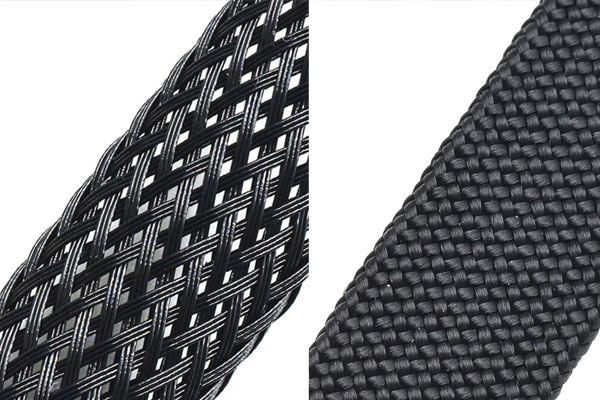
1. Structure Defines Performance: Why Monofilament Is "Stiffer" and Multifilament Is "Softer"
Monofilament Braided Sleeving
Made from single, solid filaments
Produces a firm, dimensional mesh
Excellent rigidity and elasticity
Best for high-abrasion, high-load environments
Multifilament Braided Sleeving
Made from multiple micro-fibers twisted into a yarn
Smooth, soft surface with textile-like flexibility
Conforms closely to irregular cable bundles
Ideal for flexible routing and tight installation spaces
The engineering rule of thumb:
Harsh environment? Use monofilament.
Complex routing? Use multifilament.
2. Key Technical Performance Comparison
| Feature | Monofilament | Multifilament |
| Abrasion resistance | Excellent | Moderate, for low-wear use |
| Tensile strength | High | Moderate |
| Flexibility | Medium | High |
| Complex routing capability | Medium | Excellent |
| Installation efficiency | Rigid, holds shape | Smooth and easy to work with |
| Lifecycle durability | Long, especially industrial | Medium–long depending on environment |
Heavy friction, impact, vibration - Monofilament
Tight bends, dense wiring, small enclosures-Multifilament
3. Engineering Application Scenarios
Best Uses for Monofilament
Industrial control cabinets
Robotics and drag-chain cables
Motor/servo power cables
Outdoor or mechanical wiring under stress
Why: Extremely durable, structural stability, long service life.
Best Uses for Multifilament
Dense rack wiring
Data center patch cables
Internal wiring in devices
Consumer electronics and small appliances
Why: Soft, flexible, non-abrasive, ideal for compact routing.
4. Cost, Efficiency, and Maintenance Considerations
Monofilament - Lower material cost, reduces long-term maintenance
Multifilament - Slightly higher cost, boosts installation efficiency and assembly speed